
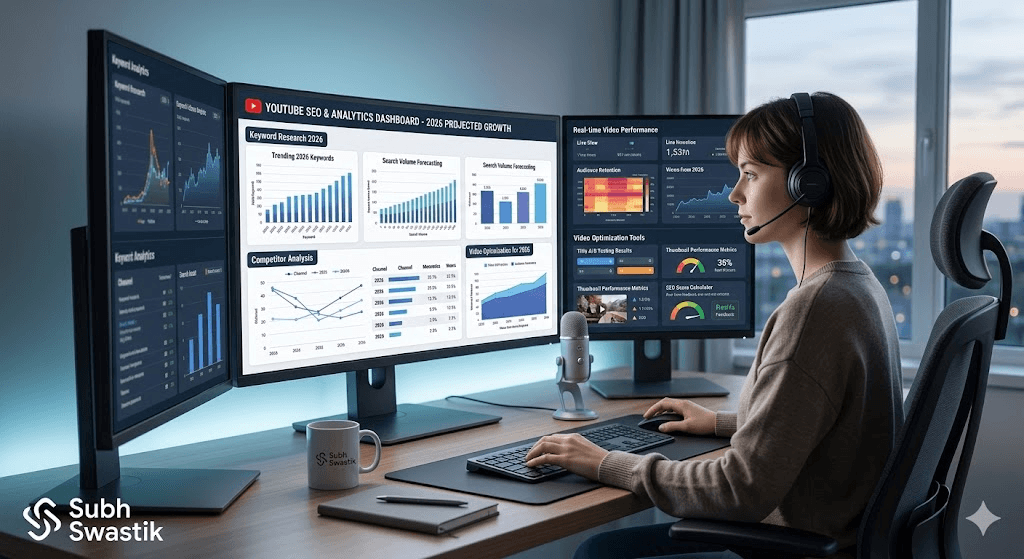
Introduction – YouTube SEO 2026
YouTube is not just a video platform—it is the world’s second-largest search engine, drawing over 48.6 billion visits every single month . That is more than Facebook (5.4x) and ChatGPT (8.7x) combined. For content creators, marketers, and businesses, this presents an incredible opportunity to reach a massive audience. But with over 500 hours of content uploaded every minute, how do you make your videos stand out ?
The answer lies in mastering YouTube SEO. At subhswastik, we understand that optimizing your videos for discoverability is no longer optional—it is essential. As search shifts toward AI-driven answers, YouTube has become a key source for platforms like Google AI Overviews, where YouTube is cited up to 29.5% of the time . This means your YouTube strategy directly impacts your visibility across the entire Google ecosystem.
Also Read: The Future of B2B Lead Generation: How a Digital Advertising Company Drives Real Business Growth
What is YouTube SEO?
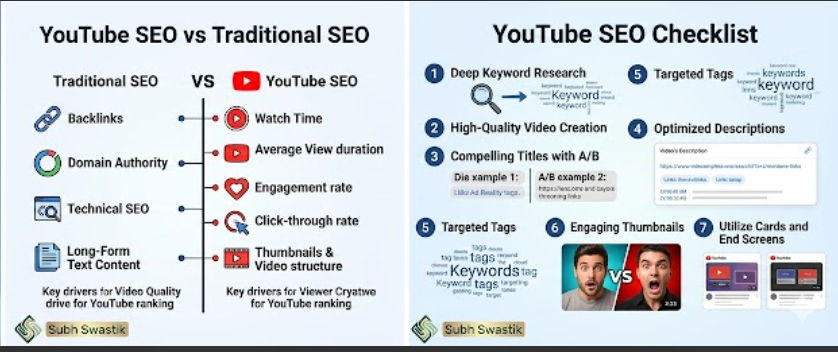
YouTube search engine optimization (SEO) is the practice of optimizing your video content, channel, and metadata to rank higher in YouTube search results and recommendations . Unlike traditional SEO, which focuses on keywords and backlinks, YouTube SEO prioritizes engagement signals—how viewers interact with your content.
Also Read: SEO Services Greater Noida: Boost Your Business with Expert Local SEO
YouTube SEO vs. Traditional SEO
| Factor | Traditional SEO (Blogs) | YouTube SEO (Video) |
|---|---|---|
| Primary Focus | Keywords, backlinks, and topical authority | Watch time, engagement, and click-through rate (CTR) |
| User Behavior Signal | Time on page, bounce rate, and clicks | Average view duration, retention, and session time |
| Content Optimization | Headings, meta tags, and structured data | Titles, descriptions, tags, captions, and file names |
| Discovery Mechanism | Search queries and knowledge graph | Search queries, recommendations, and suggested videos |
| Algorithm Goal | Match user intent with relevant text-based content | Recommend content viewers enjoy and engage with |
The goal of YouTube SEO is not just to get clicks but to keep viewers watching. As YouTube’s product lead for growth and discovery, Todd Beaupré, explains: “We’re trying to understand not just what [viewers] do, but how they feel about the time they’re spending” .
Why YouTube SEO Matters More Than Ever in 2026
YouTube has evolved from a “nice-to-have” social channel into a core SEO asset. Here is why you cannot afford to ignore YouTube optimization:
Also Read: SEO AEO GEO SXO Explained: The Evolution of Search Optimization in 2026 and Beyond
1. YouTube Dominates AI Search
Recent data from BrightEdge reveals that YouTube is the top domain cited in Google AI Overviews, appearing in up to 29.5% of them . This gives YouTube a massive 200x advantage over its closest competitor, Vimeo. When platforms like Perplexity and ChatGPT summarize answers, they frequently pull from YouTube content—especially for tutorials, product demos, and “how-to” queries .
2. Video Content Ranks Across Google
YouTube videos surface in multiple Google SERP features, including:
- Main search results
- AI Overviews
- Featured snippets
- Video carousels
- Discover feeds
A single well-optimized video can win visibility on living-room TVs, YouTube recommendations, and AI-generated answers, making it a core SEO asset .
3. Viewer Behavior is Changing
Today, people use YouTube not just for entertainment but to find answers, learn skills, and research products . Educational product information is the second most popular content type on YouTube . This means your audience is actively searching for the solutions you provide—but only if they can find your content.
Also Read: B2B Lead Generation in 2026: Why Digital Advertising Agency Strategies Are Winning
2026 YouTube SEO Checklist: 10 Steps to Rank Higher
At subhswastik, we believe in a structured approach to YouTube SEO. Here is a proven checklist to help you optimize your videos and channel for maximum discoverability.
1. Master YouTube Keyword Research
Strong YouTube SEO starts with understanding what your audience is actually searching for .
How to Find the Right Keywords:
- Use YouTube Autocomplete: Type a broad topic into the YouTube search bar and note the suggested queries—these are based on real user behavior .
- Analyze Competitors: Study high-performing competitor videos to see what keywords appear in their titles, descriptions, and tags .
- Leverage Google Trends: Select “YouTube Search” from the drop-down to explore trending topics and rising queries over time .
- Use YouTube Keyword Research Tools: Platforms like vidIQ and TubeBuddy provide search volume estimates, competition scores, and related keyword ideas .
Also Read: Top Strategies to Maximize ROI Using WhatsApp Marketing Service in 2026
💡 Pro Tip: Prioritize keywords with clear intent (tutorials, comparisons, reviews) and moderate competition. A specific phrase like “how to bake a sourdough starter at home” often performs better than a generic “baking tips.”
2. Optimize Your Video Title
Your title is one of the most important ranking signals and the first thing viewers see. It should grab attention, promise value, and include your primary keyword early .
Title Optimization Tips:
- Keep it between 50-60 characters.
- Use your primary keyword at the beginning.
- Add a hook that creates curiosity or an outcome-driven interest.
- Avoid clickbait—deliver on what you promise.
| ❌ Weak Title | ✅ Strong Title |
|---|---|
| “Small Business Marketing Tips” | “Small Business Marketing: 7 Tactics That Drive Revenue in 2026” |
| “How to Use YouTube” | “YouTube SEO: The Complete 2026 Guide for Beginners” |
3. Write a Keyword-Rich Description
Your description helps both YouTube and viewers understand what your video is about .
Description Best Practices:
- Start with a 1-2 sentence summary that includes your target keyword.
- Use the first 200 characters wisely—this appears in search results.
- Add timestamps for longer videos to improve user experience.
- Include relevant links, calls-to-action, and social handles.
- Do not stuff keywords—write naturally for humans.
Example Description Structure:
In this video, we cover YouTube SEO strategies for 2026. Learn how to rank videos on YouTube and Google using proven keyword research, optimization techniques, and analytics. 📌 Timestamps: 0:00 Intro 1:30 Keyword Research 5:10 Title & Description Optimization 8:45 Thumbnails & Engagement 📌 More Resources: [Link to blog post] [Link to related video]
4. Add Relevant Tags
Tags help YouTube understand your video’s topic. While YouTube states that tags “play a minimal role in discovery,” they can still help, especially for misspelled terms .
Tag Tips:
- Use a mix of broad and specific tags (e.g., “YouTube SEO,” “how to rank on YouTube,” “video marketing tips”).
- Include your brand name (e.g., “subhswastik YouTube tips”).
- Add misspellings or common variations of your keywords.
- Keep tags relevant—do not spam unrelated terms.
5. Customize Your Thumbnail for High CTR
Up to 90% of top-performing videos use custom thumbnails . Your thumbnail is the first visual cue viewers see, and a compelling one can significantly boost your click-through rate (CTR).
Thumbnail Design Tips:
- Use high-resolution images (1280×720 pixels).
- Feature human faces with clear emotions.
- Keep it simple—focus on one central element.
- Use contrasting colors to stand out.
- Add your logo or brand as a watermark .
6. Create YouTube Playlists to Increase Watch Time
Playlists are a powerful tool for improving session duration and watch time . Group your related videos into playlists with keyword-rich titles and descriptions.
Playlist Benefits:
- Encourages viewers to watch multiple videos in one session.
- Signals topical authority to YouTube.
- Improves overall channel metrics.
Example: If you create a series on YouTube SEO, make a playlist called “YouTube SEO Masterclass 2026” with all related videos.
7. Use Cards and End Screens
Cards and end screens keep viewers engaged with your content longer .
- Cards: Clickable links that appear during a video—use them to promote related content, playlists, or channels.
- End Screens: Appear in the last 5-20 seconds—promote additional videos, encourage subscriptions, or push viewers to a playlist.
8. Encourage Engagement
Engagement signals (likes, comments, shares, and subscriptions) tell YouTube that your content is valuable .
Ways to Encourage Engagement:
- Ask viewers a question at the end of your video.
- Use pinned comments to spark discussion.
- Encourage viewers to “like” and “subscribe.”
- Respond to comments to build community.
9. Add Captions and Transcripts
Captions and transcripts are essential for both accessibility and SEO. They provide text that YouTube’s crawlers can analyze to understand your video’s content.
Caption Tips:
- Upload your own transcript instead of relying solely on auto-captions.
- Ensure your transcript includes your target keywords naturally.
- Make sure captions are accurate and timed correctly.
10. Analyze Your Performance with YouTube Analytics
SEO is not a “set it and forget it” task. At subhswastik, we recommend regularly reviewing your YouTube Analytics to understand what is working and what needs improvement.
Key Metrics to Track:
| Metric | What It Tells You |
|---|---|
| Watch Time | Total minutes viewers spend on your content |
| Average View Duration | How long people watch before leaving |
| Click-Through Rate (CTR) | Percentage of impressions that result in a click |
| Engagement | Likes, comments, shares, and subscription rates |
| Traffic Sources | Where viewers find your videos (search, recommendations, etc.) |
YouTube SEO Tools: Free and Paid Options
The right tools can save you time and give you a competitive edge. Here are some of the most popular YouTube SEO tools :
| Tool | Best For | Pricing |
|---|---|---|
| vidIQ | Keyword research, analytics, and trend alerts | Free & Paid ($9.99+/month) |
| TubeBuddy | Keyword explorer, tag suggestions, and rank tracking | Free & Paid |
| KeywordTool.io | Generating hundreds of related keywords from YouTube autocomplete | Free & Paid |
| Google Trends | Monitoring topic interest over time on YouTube search | Free |
| TubeLITE | AI-powered title, description, and tag generation for faster uploads | Free |
YouTube SEO Courses and Certifications
If you want to take your skills to the next level, consider formal training. The IIT Kanpur AI Marketing course provides a strong foundation in modern marketing technologies. Additionally, platforms like Coursera offer specialized YouTube growth courses .
Key Skills Covered in YouTube SEO Courses:
- Advanced keyword research for video content.
- Optimizing video metadata for search engines .
- Understanding the YouTube algorithm and ranking factors .
- Analytics and performance tracking for video SEO .
- Leveraging AI tools for content optimization.
Conclusion
YouTube SEO in 2026 is not optional—it is a core part of any successful digital strategy. By focusing on audience intent, engagement, and smart optimization, you can improve your video rankings on YouTube and Google. As we have seen, YouTube is now a key source for AI-driven search, making it more important than ever to include video in your SEO planning.
Whether you are just starting out or looking to refine your strategy, the steps above will help you build a channel that attracts viewers, keeps them engaged, and grows your brand. At subhswastik, we believe in creating content that works for both people and search engines. Start optimizing your videos today and watch your channel grow.
FAQ Section
Q1: What is YouTube SEO, and why is it important?
A1: YouTube SEO is the practice of optimizing your videos and channel to rank higher in YouTube search and recommendations. It is important because YouTube is the second-largest search engine, and optimizing your content helps you reach a wider audience and appear in Google AI Overviews .
Q2: How can I find the best keywords for YouTube SEO?
A2: You can find keywords by using YouTube’s autocomplete, analyzing competitor videos, using tools like vidIQ or TubeBuddy, and checking Google Trends for YouTube search data .
Q3: What are the most important YouTube SEO ranking factors?
A3: Key ranking factors include watch time, click-through rate (CTR), viewer retention, engagement (likes, comments, shares), and relevance of metadata (titles, descriptions, tags) .
Q4: Are there any free YouTube SEO tools available?
A4: Yes, many tools offer free versions, including vidIQ, TubeBuddy, Google Trends, and TubeLITE for AI-generated metadata .
Q5: How does AI impact YouTube SEO in 2026?
A5: AI is now central to YouTube’s algorithm and discovery systems. YouTube content is also heavily cited in AI-powered search results like Google AI Overviews, making video optimization essential for visibility across platforms.


Leave a Reply